



Breakthrough Cancer Treatment: Scientists Create Cancer-Fighting Cells Inside the Body
 26 March,2026
Read More
26 March,2026
Read More


Enquire now in case of any assistance needed
30 July,2025
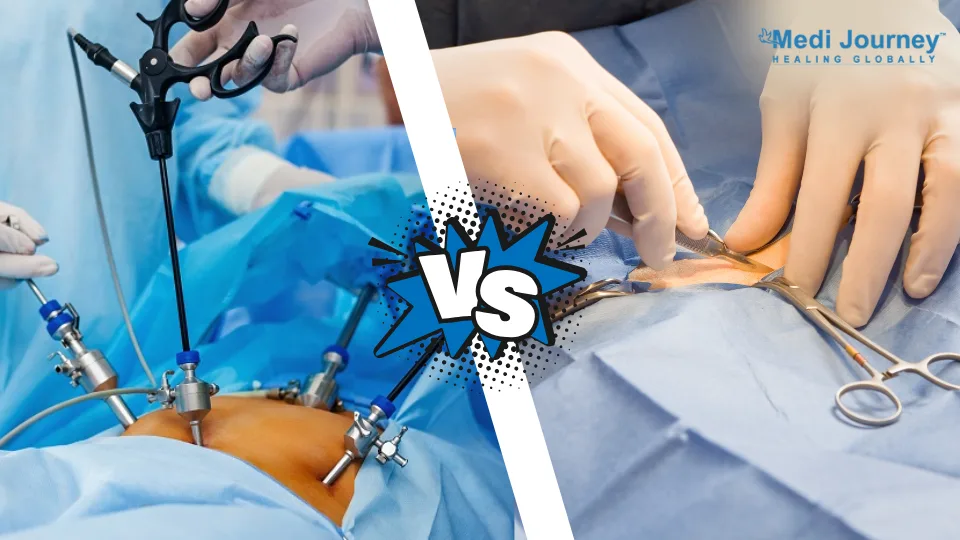
Minimally invasive surgery has changed the way procedures are done. Instead of significant cuts and long recovery times, MIS uses small incisions. The method also involves advanced tools and cameras to perform the same procedures with less damage to the body. The approach is commonly employed in areas such as orthopedics, gynecology, and abdominal surgery.
The procedure is new-age and has a faster healing rate with reduced pain to lower infection risk. There are key advantages that make this method a safer and effective option. We have outlined a blog to help you understand what minimally invasive surgery is, how it compares to traditional open surgery, and why more patients and doctors are choosing it.
Fill up the form and get assured assitance within 24 hrs!
Minimally invasive surgery (MIS) is also known as robot-assisted surgery. It is an operation procedure that is undertaken through small incisions using special instruments, cameras, and imaging aids. This method causes less damage to surrounding tissues compared to open surgery, which requires larger incisions to access the surgical area. The surgery consists of below methods:
Here’s an overview of how different minimally invasive techniques are applied across various surgical procedures:
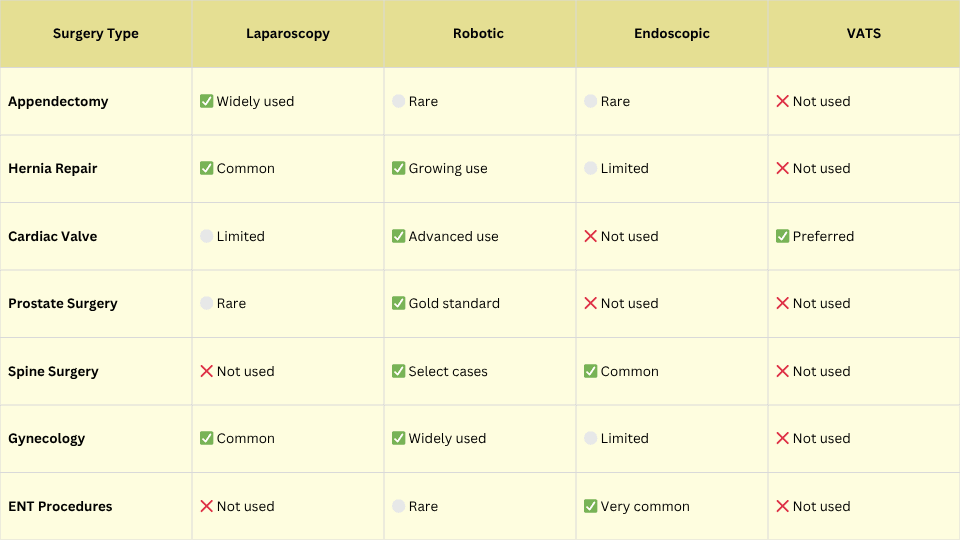
As the table shows, some procedures like appendectomy and hernia repair are almost always done laparoscopically, while robotic surgery dominates in prostate and cardiac surgeries. On the other hand, ENT and spine surgeries benefit greatly from endoscopic approaches, offering higher precision with minimal trauma.
The technique chosen often depends on the surgeon’s experience, the available technology, and the patient's suitability.
Get help choosing the best doctor and hospital for your care.
In open surgery, incisions are used that are large to have a direct view of the operative field. Although it is effective, it tends to involve large numbers of tissue dissections, a prolonged hospital stay, postoperative pain, and is highly visible.
Minimally invasive surgery, in contrast, applies to access the internal target via the small portals or natural orifices. The surgeons operate through cameras and small tools. In robot surgery, the doctors sit in a console and use tools with a high degree of precision. The objectives of these techniques include minimizing collateral tissue damage to achieve specific surgical goals.
Minimally invasive surgery typically results in less bleeding due to smaller incisions and more precise tissue handling, which lowers the risk of complications and reduces the need for blood transfusions.
Smaller wounds heal faster and are less prone to infection; minimally invasive techniques have also been linked to fewer postoperative complications overall.
Many patients undergoing minimally invasive surgery go home within a day or two, or even the same day. Return to daily activities and work is often quicker, sometimes within days.
Incisions are typically small, and the scars often fade to nearly invisible within months, which benefits many patients both physically and psychologically.
Reduced surgical trauma means less systemic stress, which can speed recovery and preserve immune function, especially important in frail or elderly patients.
Advances in image guidance (like real?time navigation in spine surgery) and robotics enhance accuracy and control. Navigation-assisted endoscopic spine surgery, for instance, utilizes infrared trackers and body-mapping technology akin to Google Maps, enabling millimeter precision and reducing radiation exposure. Robotic systems approved in NHS England now enable precision in hernia, hip/knee, tumour, gallbladder, and prostate surgeries.
Less invasive options make surgery feasible for older, obese, or comorbid patients who might not tolerate open surgery, e.g., minimally invasive cardiac or spinal procedures.
Get help choosing the best doctor and hospital for your care.
Despite its many benefits, minimally invasive surgery isn't suitable for every case. Below are some key limitations and considerations to keep in mind:
|
Aspect |
Minimally Invasive Surgery (MIS) |
Traditional Open Surgery |
|
Incision size |
Small, multiple, or single keyhole entries |
Large open incisions |
|
Tissue trauma |
Minimal |
Significant muscle/tissue disruption |
|
Pain & narcotic usage |
Less postoperative pain, reduced analgesics |
More pain, higher narcotic requirement |
|
Blood loss |
Typically minimal |
Higher risk of bleeding |
|
Hospital stay |
Shorter stay; often same-day or 1–2 days |
Longer stays, multi-day hospitalization |
|
Recovery & return to work |
Faster post-op recovery |
Prolonged recovery period |
|
Infection risk |
Lower |
Higher |
|
Cosmetic outcome |
Small, less visible scars |
Large scar visibility |
|
Specialized equipment |
Advanced tools: cameras, robotic systems, navigation |
Minimal special equipment needed |
|
Cost |
Higher equipment/training cost; potential long-term savings |
Standard infrastructure |
|
Surgeon skill & learning curve |
High – requires special training |
Well-established and widespread |
Minimally Invasive Surgery has unquestionable benefits over conventional open surgery due to its lower incidence of trauma, bleeding, pain, and complications, in addition to faster recovery and maintenance of cosmetic results in most situations. The profession is evolving rapidly with the emergence of new tools, including robotics, Artificial Intelligence (AI), augmented reality, and single-port methodologies.
Minimally invasive surgery is widely available at several top-tier hospitals across India. Apollo Hospitals, with branches in Delhi, Bangalore, Chennai, Hyderabad, and Mumbai, offers advanced laparoscopic and robotic procedures across specialities. Aster Medcity in Kochi features India’s first MARS (Minimal Access Robotic Surgery) program in Kerala using the Da Vinci Surgical System. Narayana Multispeciality Hospitals in Jaipur and Ahmedabad provide minimally invasive cardiac, spine, and neurosurgical services. In Bangalore, both Gleneagles BGS Hospital and Manipal Hospital are recognised for their comprehensive MIS offerings. These hospitals offer global-standard MIS protocols.
Small incisions, reduced postoperative pain, faster recovery, and high safety when performed in NABH or JCI-accredited facilities by expert providers. If you're wondering about the availability of minimally invasive surgery in India, these centres are reputable choices, backed by accreditation and advanced surgical infrastructure.
With the ongoing transformation in technology and the increased availability of said technology, particularly in places such as India, MIS is on the rise to become not only a desirability but also a standard of care in most surgical specialties.
Connect with MediJourney today to get access to the best hospitals offering minimally invasive surgery. We are your trusted healthcare partner to make your treatment and recovery journey worry-free.
Fill up the form and get assured assitance within 24 hrs!
B.Sc in Media Science from NSHM Knowledge Campus, Kolkata, 2019-2022
Suryani Dutta is an experienced healthcare content writer with 4+ years of experience creating patient-centric healthcare content. She has developed over 2,000 blogs and web pages, 2,000+ social media creatives, 200+ video scripts, and hundreds of SEO-opt
Director
Hepatologist, HPB and Liver Transplant Surgeon, Surgical Gastroenterologist
Aakash Healthcare Super Speciality Hospital, Dwarka, New Delhi
Dr. Ajitabh Srivastava is one of the best Hepatologists, Surgical Gastroenterologists, and Liver Transplant Surgeons in New Delhi. With over 26 years of experience, he has performed over 2500 liver transplant procedures. He specializes in hepato-pancreato-biliary (HPB) surgery, gastrointestinal surgery, acute liver failure treatment, laparoscopic surgery, and gall bladder surgery....
Senior Consultant
Medical Oncologist
Nanavati Max Super Speciality Hospital Mumbai
WhatsApp UsSenior Director
Gynecologist and Obstetrician, IVF Specialist
Max Super Speciality Hospital, Shalimar Bagh, New Delhi
WhatsApp UsSenior Director
Gynecologist and Obstetrician, IVF Specialist
Max Smart Super Speciality Hospital, Saket, New Delhi
WhatsApp UsSenior Director
Gynecologist and Obstetrician
Max Smart Super Speciality Hospital, Saket, New Delhi
WhatsApp UsSenior Director
Gynecologist and Obstetrician
Max Smart Super Speciality Hospital, Saket, New Delhi
WhatsApp UsSenior Director
Gynecologist and Obstetrician
Max Smart Super Speciality Hospital, Saket, New Delhi
WhatsApp UsThe Art of Effective Communication
04 February,2026
Read More
02 February,2026
Read More
27 January,2026
Read More
20 January,2026
Read More
Trusted by Patients
"I am Asim from Bangladesh and was looking for treatment in India for neuro. I visited many websites to get the complete information regarding the treatment but I was not satisfied as I was getting confused. In the meanwhile, one of my friends suggested I seek help from Medi Journey as he experienced his medical journey very smoothly and was satisfied with it. They have filtered the top 10 doctors as per experience, the success rate of surgery & profile, so it helps us to choose the best treatment in India. "
"For my knee surgery, Medi Journey guided me to BLK Hospital where I received exceptional care. The team's support and the expertise at BLK Hospital exceeded my expectations. Thank you Medi Journey for making my medical journey stress-free. "
"I came from Iraq for my granddaughter's eye surgery in India facilitated by Medi Journey, due to critical cases they advised us to get a second opinion from the different hospitals before going to surgery. Finally, we went to Fortis Escort Hospital, which helped us to get more confidence for diagnosis. Fortis Escort Hospital has the best eye surgeon team with the latest instruments. Thanks to all team members for providing a high-quality treatment in India at an affordable cost. "
"I came for my hair transplant in India, before coming I was so confused about choosing the best clinic and surgeon for me. But thanks to God one of my friends had a hair transplant in India through Medi Journey. He recommended me to go with them. I am completely happy with my experience with them. They were always very fast in their responses to me. the success rate of my hair transplant surgery is 100%."
"Artemis Hospital, suggested by Medi Journey, turned out to be a great choice for my treatment. The personalized assistance and medical care were exceptional. I'm grateful to Medi Journey for guiding me to a hospital that perfectly matched my needs. Highly recommended! "
"I came from Afghanistan for my treatment in India at Jaypee Hospital, Noida. I had a fantastic experience with Medi Journey. Kudos to them for their incredible support during my medical journey. They not only took care of all the logistics but also connected me with a fantastic healthcare team. Efficient, caring, and highly recommended for a hassle-free medical tourism experience."
"I am Adam from Kano, Nigeria, one of my friends from Nigeria was facilitated by Medi Journey, and he recommended us to go with them. I sent my all reports to them and within 48 hours they reverted with 4 options from different hospitals. They helped me to get a Visa letter from the hospital, arrange pick-up from the airport, and book a hotel for me. Their team is very honest and throughout our stay in India they are with us they are caring for us like his family members. BLK Hospital is the best hospital in India with a top surgical oncologist surgeon team, a very advanced OT, and a Radiotherapy department. I wish more success to Medi Journey. "
"Great experience at the Max Hospital for my spine surgery and was successfully done. I thank my neurosurgeon and his entire team. I recommended all of my country's people to Medi Journey for treatment in India, they choose the best hospital, the best doctors, and the best cost for patients."
"I came to India from Dhaka, Bangladesh for my father-in-law's cardiac surgery at Fortis Hospital. I was confused about choosing the best surgeon for him before coming, but their team helped me to choose the best hospital and best cardiac surgeon in India with very good cost and 100% success rate of surgery. I am very happy with the services, really they make my journey so comfortable that make me feel at home. Thanks again and I like people to choose "Medi Journey" as your travel guide. "
"I am Mohammad from Bangladesh came to India for my general health checkup. Medi Journey offers me the complete package including Pick-up from the airport, hotel services, and 24-hour assistance. They guide you to choose the best hospital in India, the best cost of treatment with top-most doctors and give you complete information about hotel booking, and pick-up from the airport before coming to India They have the best team to help. Always choose Medi Journey for your treatment in India."