

Breakthrough Cancer Treatment: Scientists Create Cancer-Fighting Cells Inside the Body
 26 March,2026
Read More
26 March,2026
Read More


Enquire now in case of any assistance needed
29 July,2025
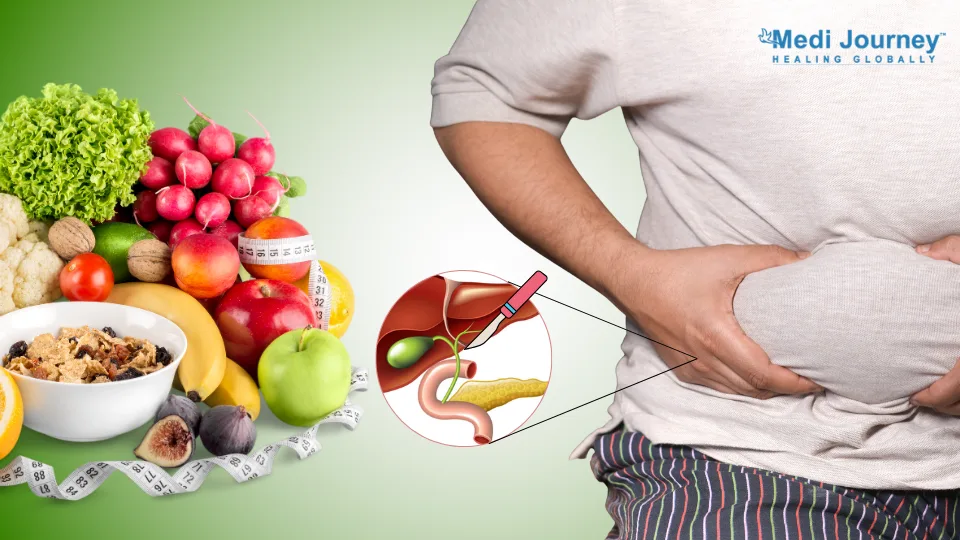
Gallbladder removal, also known as cholecystectomy, is one of the most common surgical procedures performed worldwide. While the surgery usually brings relief from painful gallstones or gallbladder inflammation, it does require some adjustments, especially in how and what you eat. Your gallbladder plays a crucial role in storing bile, which aids in the digestion of fats. Without it, bile flows directly into your small intestine, which may affect how your body handles fat-rich or spicy meals.
So, what exactly should you eat after surgery? How can you maintain smooth digestion and avoid discomfort? This blog will explore what to eat and avoid, along with helpful tips for managing your diet after gallbladder removal. Whether you’re recovering from surgery or helping a loved one manage their new diet, this guide is packed with useful, real-life advice.
Fill up the form and get assured assitance within 24 hrs!
The gallbladder stores bile to release it when needed, usually when you consume meals high in fat. Once the organ is removed, your liver continues to produce bile, but instead of being stored, it flows continuously into your digestive system. This slow, steady release isn’t always sufficient to handle a fatty meal all at once. That’s why people often experience bloating, indigestion, diarrhea, or gas after surgery.
Adopting the right diet after gallbladder removal can help your digestive system adjust and function efficiently without causing distress.
Get help choosing the best doctor and hospital for your care.
Before going into the specifics of what to eat and avoid, here are a few ground rules for diet after gallbladder removal:
Let’s break down what you should eat as part of your diet after gallbladder removal to keep things easy on your stomach.
Choose easy-to-digest protein sources that are low in fat:
These options are gentle and help with tissue repair without overloading your system with fat.
Fruits and veggies are rich in fiber, vitamins, and antioxidants. However, introduce fiber slowly:
Whole grains help bulk up stool and ease digestion, but don’t go overboard initially:
Start with small portions and observe how your body responds.
Your body still needs fats, but only in limited amounts, as diet after gallbladder removal:
Introducing these slowly can help you maintain energy without upsetting your digestion.
These are ideal in the early days after surgery:
They hydrate, nourish, and are easy on the gut.
Get help choosing the best doctor and hospital for your care.
Some foods are more difficult to digest and may cause discomfort. Avoid these as part of your diet after gallbladder removal:
These put a strain on your digestive system:
Many processed foods contain unhealthy fats and additives:
They can cause bloating, diarrhea, and slow healing:
Avoid these during the first few weeks:
To make it easier to understand, here’s a visual comparison of common food groups and how risky they can be for your digestion after surgery:
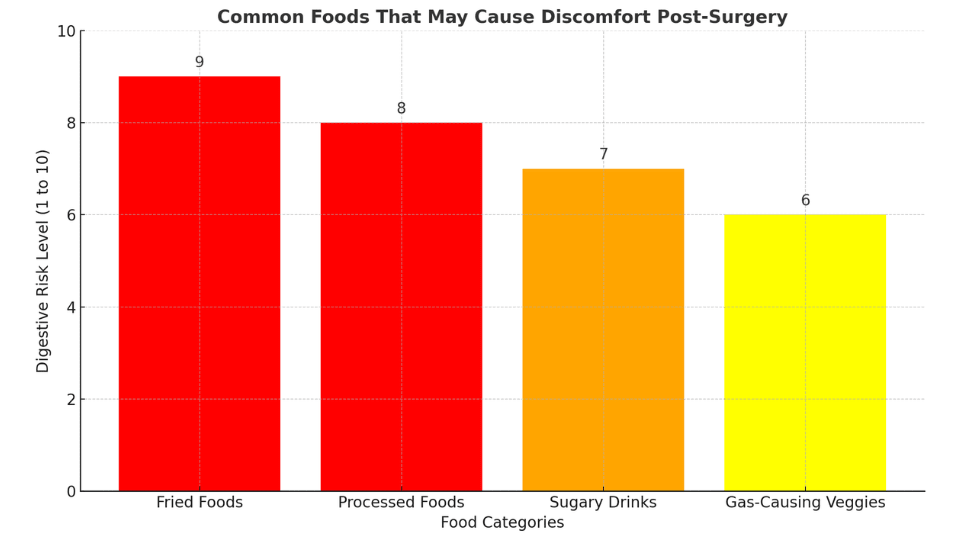
This bar graph highlights the digestive risk level (on a scale of 1 to 10) for major food categories that should be avoided during recovery from gallbladder removal.
|
Food Category |
Digestive Risk Level (1–10) |
|
Fried Foods |
9 (High Risk) |
|
Processed Foods |
8 (High Risk) |
|
Sugary Drinks |
7 (Moderate to High Risk) |
|
Gas-Causing Vegetables |
6 (Moderate Risk) |
Tip: Even after the initial recovery phase, it's best to limit these foods and reintroduce only small portions while monitoring your body’s reaction.
To simplify your diet, here’s a sample weekly plan to consider:
Get help choosing the best doctor and hospital for your care.
Even with a balanced diet after gallbladder removal surgery, some people may face occasional issues. Here’s how to handle them:
Some foods may be tolerated again after a few months after surgery. But patience is important.
Always introduce one food at a time to monitor your body’s response.
Get help choosing the best doctor and hospital for your care.
You don’t need to follow a restrictive diet forever. For the first 4–6 weeks, adhering to strict food choices helps your body adjust. After that, you can gradually reintroduce most foods based on your tolerance. However, some people may permanently reduce their intake of fried or fatty foods, depending on the severity of their symptoms.
Listening to your body is key. If something causes pain or bloating, skip it and try again later.
Adjusting to a new diet after gallbladder removal takes time, but it’s entirely manageable with the right choices and consistency. By eating smaller portions, limiting fat intake, and gradually reintroducing food tolerance, most people can return to enjoying a wide range of meals. Your digestive system may take several weeks to months to fully adapt, but being mindful now can help you avoid long-term discomfort.
If symptoms like persistent diarrhea, weight loss, or severe pain continue, consult a gastroenterologist to rule out complications like bile acid malabsorption or postcholecystectomy syndrome.
Ultimately, the goal isn’t just to avoid discomfort but to support your long-term health. And that begins with eating well, even if your gallbladder’s gone. Connect with top doctors in India or learn more about our hospitals in India – visit us now!
Fill up the form and get assured assitance within 24 hrs!
B.Sc in Media Science from NSHM Knowledge Campus, Kolkata, 2019-2022
Suryani Dutta is an experienced healthcare content writer with 4+ years of experience creating patient-centric healthcare content. She has developed over 2,000 blogs and web pages, 2,000+ social media creatives, 200+ video scripts, and hundreds of SEO-opt
Director
Hepatologist, HPB and Liver Transplant Surgeon, Surgical Gastroenterologist
Aakash Healthcare Super Speciality Hospital, Dwarka, New Delhi
Dr. Ajitabh Srivastava is one of the best Hepatologists, Surgical Gastroenterologists, and Liver Transplant Surgeons in New Delhi. With over 26 years of experience, he has performed over 2500 liver transplant procedures. He specializes in hepato-pancreato-biliary (HPB) surgery, gastrointestinal surgery, acute liver failure treatment, laparoscopic surgery, and gall bladder surgery....
Senior Consultant
Medical Oncologist
Nanavati Max Super Speciality Hospital Mumbai
WhatsApp UsSenior Director
Gynecologist and Obstetrician, IVF Specialist
Max Super Speciality Hospital, Shalimar Bagh, New Delhi
WhatsApp UsSenior Director
Gynecologist and Obstetrician, IVF Specialist
Max Smart Super Speciality Hospital, Saket, New Delhi
WhatsApp UsSenior Director
Gynecologist and Obstetrician
Max Smart Super Speciality Hospital, Saket, New Delhi
WhatsApp UsSenior Director
Gynecologist and Obstetrician
Max Smart Super Speciality Hospital, Saket, New Delhi
WhatsApp UsSenior Director
Gynecologist and Obstetrician
Max Smart Super Speciality Hospital, Saket, New Delhi
WhatsApp UsThe Art of Effective Communication
04 February,2026
Read More
02 February,2026
Read More
27 January,2026
Read More
20 January,2026
Read More
Trusted by Patients
"I am Asim from Bangladesh and was looking for treatment in India for neuro. I visited many websites to get the complete information regarding the treatment but I was not satisfied as I was getting confused. In the meanwhile, one of my friends suggested I seek help from Medi Journey as he experienced his medical journey very smoothly and was satisfied with it. They have filtered the top 10 doctors as per experience, the success rate of surgery & profile, so it helps us to choose the best treatment in India. "
"For my knee surgery, Medi Journey guided me to BLK Hospital where I received exceptional care. The team's support and the expertise at BLK Hospital exceeded my expectations. Thank you Medi Journey for making my medical journey stress-free. "
"I came from Iraq for my granddaughter's eye surgery in India facilitated by Medi Journey, due to critical cases they advised us to get a second opinion from the different hospitals before going to surgery. Finally, we went to Fortis Escort Hospital, which helped us to get more confidence for diagnosis. Fortis Escort Hospital has the best eye surgeon team with the latest instruments. Thanks to all team members for providing a high-quality treatment in India at an affordable cost. "
"I came for my hair transplant in India, before coming I was so confused about choosing the best clinic and surgeon for me. But thanks to God one of my friends had a hair transplant in India through Medi Journey. He recommended me to go with them. I am completely happy with my experience with them. They were always very fast in their responses to me. the success rate of my hair transplant surgery is 100%."
"Artemis Hospital, suggested by Medi Journey, turned out to be a great choice for my treatment. The personalized assistance and medical care were exceptional. I'm grateful to Medi Journey for guiding me to a hospital that perfectly matched my needs. Highly recommended! "
"I came from Afghanistan for my treatment in India at Jaypee Hospital, Noida. I had a fantastic experience with Medi Journey. Kudos to them for their incredible support during my medical journey. They not only took care of all the logistics but also connected me with a fantastic healthcare team. Efficient, caring, and highly recommended for a hassle-free medical tourism experience."
"I am Adam from Kano, Nigeria, one of my friends from Nigeria was facilitated by Medi Journey, and he recommended us to go with them. I sent my all reports to them and within 48 hours they reverted with 4 options from different hospitals. They helped me to get a Visa letter from the hospital, arrange pick-up from the airport, and book a hotel for me. Their team is very honest and throughout our stay in India they are with us they are caring for us like his family members. BLK Hospital is the best hospital in India with a top surgical oncologist surgeon team, a very advanced OT, and a Radiotherapy department. I wish more success to Medi Journey. "
"Great experience at the Max Hospital for my spine surgery and was successfully done. I thank my neurosurgeon and his entire team. I recommended all of my country's people to Medi Journey for treatment in India, they choose the best hospital, the best doctors, and the best cost for patients."
"I came to India from Dhaka, Bangladesh for my father-in-law's cardiac surgery at Fortis Hospital. I was confused about choosing the best surgeon for him before coming, but their team helped me to choose the best hospital and best cardiac surgeon in India with very good cost and 100% success rate of surgery. I am very happy with the services, really they make my journey so comfortable that make me feel at home. Thanks again and I like people to choose "Medi Journey" as your travel guide. "
"I am Mohammad from Bangladesh came to India for my general health checkup. Medi Journey offers me the complete package including Pick-up from the airport, hotel services, and 24-hour assistance. They guide you to choose the best hospital in India, the best cost of treatment with top-most doctors and give you complete information about hotel booking, and pick-up from the airport before coming to India They have the best team to help. Always choose Medi Journey for your treatment in India."