


Breakthrough Cancer Treatment: Scientists Create Cancer-Fighting Cells Inside the Body
 26 March,2026
Read More
26 March,2026
Read More


Enquire now in case of any assistance needed
07 August,2025
Fill up the form and get assured assitance within 24 hrs!
Surgery is a vital part of treating various medical conditions, but it also puts the body under significant stress. During and after the operation, your body activates healing processes. In many cases, this can increase the risk of blood clots.
One of the most serious complications is deep vein thrombosis (DVT). A condition where clots form in the deep veins, primarily in the legs. If a clot breaks loose, it can travel to the lungs and cause a life-threatening condition called pulmonary embolism (PE).
Fortunately, the DVT prevention routine has become a core part of post-operative care, especially for patients undergoing orthopedic, abdominal, or cancer-related surgeries. Also, by following simple guidelines and being aware of the signs, patients significantly reduce the chances of developing blood clots after surgery and enjoy a safer recovery.
In this blog, we will walk you through the primary steps to reduce the risk of clotting. Our steps are aimed at keeping your circulation healthy even after surgery.
Get help choosing the best doctor and hospital for your care.
Deep vein thrombosis (DVT) occurs when a blood clot forms in one of the deep veins, typically in the lower leg or thigh. After surgery, limited movement can slow down blood flow, which increases the chances of clot formation. If left untreated, a DVT can break off and travel to the lungs, leading to a life-threatening pulmonary embolism (PE).
Common symptoms of DVT include:
However, not all DVTs cause noticeable symptoms, making prevention even more critical.
Surgeries, especially orthopedic, abdominal, or pelvic procedures, place patients at a higher risk of developing DVT for several reasons:
Understanding these risk factors is the first step toward DVT prevention and a safer recovery process.
Below is a breakdown of the types of surgeries most commonly associated with DVT risk:

As shown, orthopedic surgeries like knee or hip replacements account for the highest risk (40%), followed by abdominal (25%) and cancer-related procedures (20%).
Modern protocols encourage personalized assessments for VTE and bleeding risks, helping to shape effective prevention strategies. This approach ensures that each patient receives care according to their specific needs, making prevention efforts more effective and supportive.
Get help choosing the best doctor and hospital for your care.
One of the most effective methods of DVT prevention is early mobilization. Doctors often recommend getting up and walking as soon as it’s safe post-surgery. Even light leg movements in bed, like ankle rolls or flexing your toes, can help keep the blood flowing.
Tip: Set a timer to remind yourself to move your legs every hour while awake, even if you're lying down.
Compression stockings help improve circulation by applying gentle pressure to the legs, reducing venous stasis (blood pooling). They’re often prescribed after procedures like hip or knee replacements and can significantly lower the risk of blood clots after surgery. However, stockings are not suitable for patients with certain vascular diseases, neuropathy, or skin conditions.
Make sure to:
Adequate hydration keeps the blood from becoming too thick. Dehydration, which often occurs after surgery due to fasting, medications, or reduced intake, can increase the risk of clots.
Tip: Aim for 8–10 glasses of water per day unless advised otherwise by your physician.
Always follow physician-specific guidance on fluid restrictions
Doctors may prescribe blood thinners (anticoagulants) for high-risk patients after surgery. These medications help prevent clot formation. Commonly used anticoagulants include warfarin, enoxaparin, and newer oral agents like apixaban or rivaroxaban.
Be sure to:
For orthopedic surgeries (like hip/knee replacements), prophylaxis is often needed for at least 10–14 days, and sometimes up to 35 days after surgery.
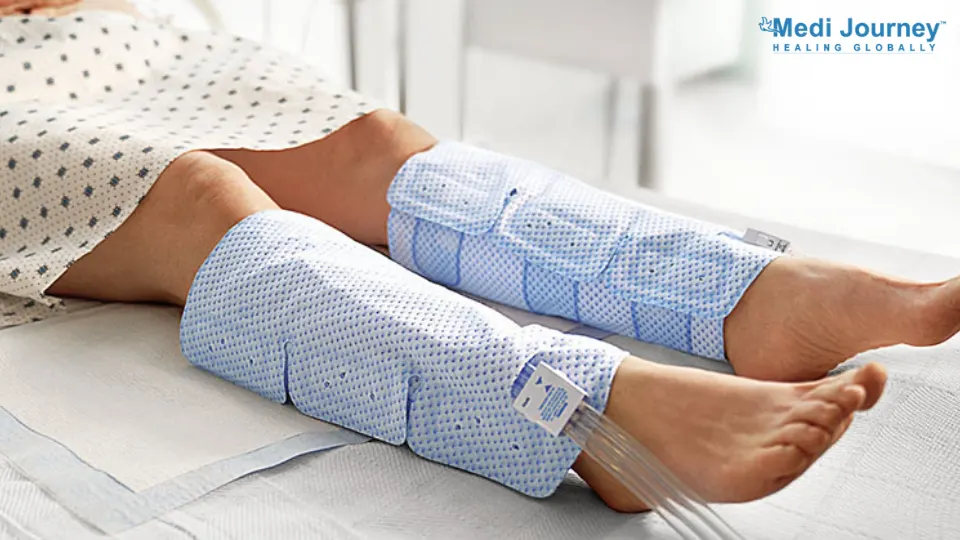
Hospitals often use pneumatic compression devices, cuffs that inflate and deflate, to mimic the natural pumping of leg muscles. These are especially beneficial for immobile patients and work well alongside other methods of DVT prevention.
Mechanical methods like sequential compression devices are mainly used when medication isn't suitable, such as for patients with a high bleeding risk, or alongside other treatments. They're not typically the only preventive measure for patients at high risk.
Smoking affects circulation and increases your risk of blood clots. If you're scheduled for surgery, consider quitting before the procedure and avoid resuming afterwards. Many hospitals offer cessation support to help patients make this transition.
Your risk of developing DVT increases if you have:
If you fall into one or more of these categories, your doctor will create a personalized prevention plan for you.
Elevating your legs above heart level can help reduce swelling and improve blood flow. Use a pillow or cushion to support your legs while lying down. This simple trick can support overall circulation and help prevent blood clots after surgery.
Adhering to your surgeon's aftercare plan is critical. This includes attending follow-up appointments, taking medications on time, and reporting any unusual symptoms immediately. Early detection and intervention can stop a clot from becoming life-threatening.
Call your doctor or go to the emergency room if you experience:
These may be signs of a pulmonary embolism and require urgent care.
Preventing complications after surgery is not entirely the doctor’s job. Patients have a decisive role as well. Whether it is recovering from a minor operation or a major procedure, our simple steps, which we mentioned above, can help you stay safe. Remember, precaution is better, and DVT prevention is most successful when approached with a combination of medical guidance and patient action.
You are taking a crucial step towards recovery by staying active, hydrated, and being aware of your body. Preventing blood clots after surgery doesn’t have to be complicated if we follow a few consistent habits, like wearing compression stockings and taking prescribed medications, or getting up to walk: simple habits but a big difference.
If you are looking for reputed doctors and hospitals for consultation, contact MediJourney today. Our case manager can guide you and help you with the logistics as well.
Fill up the form and get assured assitance within 24 hrs!
B.Sc in Media Science from NSHM Knowledge Campus, Kolkata, 2019-2022
Suryani Dutta is an experienced healthcare content writer with 4+ years of experience creating patient-centric healthcare content. She has developed over 2,000 blogs and web pages, 2,000+ social media creatives, 200+ video scripts, and hundreds of SEO-opt
Chairman
Cardiac Electrophysiologist, Interventional Cardiologist
Dr. T.S. Kler, a Padma Bhushan awardee and the Chairman of Fortis Heart & Vascular Institute, transformed the field of electrophysiology in India through over 35,000 angioplasties and innovative device implants. After earning the MRCP (UK) in 1989, he launched India's first electrophysiology lab at Escorts Heart Institute in 1993, where he conducted the country's first ICD implant in 1995 and the first CRT-D implant in 2000. His introduction of HIS bundle pacing in 2015 resulted in a 30% improvement in cardiac synchronization outcomes. He is one of the leading doctors in Gurgaon, India, and he is currently focused on integrating AI-driven models for arrhythmia prediction, analyzing over 10,000 ECGs with a machine learning algorithm....
Senior Consultant
Medical Oncologist
Nanavati Max Super Speciality Hospital Mumbai
WhatsApp UsSenior Director
Gynecologist and Obstetrician, IVF Specialist
Max Super Speciality Hospital, Shalimar Bagh, New Delhi
WhatsApp UsSenior Director
Gynecologist and Obstetrician, IVF Specialist
Max Smart Super Speciality Hospital, Saket, New Delhi
WhatsApp UsSenior Director
Gynecologist and Obstetrician
Max Smart Super Speciality Hospital, Saket, New Delhi
WhatsApp UsSenior Director
Gynecologist and Obstetrician
Max Smart Super Speciality Hospital, Saket, New Delhi
WhatsApp UsSenior Director
Gynecologist and Obstetrician
Max Smart Super Speciality Hospital, Saket, New Delhi
WhatsApp UsThe Art of Effective Communication
04 February,2026
Read More
02 February,2026
Read More
27 January,2026
Read More
20 January,2026
Read More
Trusted by Patients
"I am Asim from Bangladesh and was looking for treatment in India for neuro. I visited many websites to get the complete information regarding the treatment but I was not satisfied as I was getting confused. In the meanwhile, one of my friends suggested I seek help from Medi Journey as he experienced his medical journey very smoothly and was satisfied with it. They have filtered the top 10 doctors as per experience, the success rate of surgery & profile, so it helps us to choose the best treatment in India. "
"For my knee surgery, Medi Journey guided me to BLK Hospital where I received exceptional care. The team's support and the expertise at BLK Hospital exceeded my expectations. Thank you Medi Journey for making my medical journey stress-free. "
"I came from Iraq for my granddaughter's eye surgery in India facilitated by Medi Journey, due to critical cases they advised us to get a second opinion from the different hospitals before going to surgery. Finally, we went to Fortis Escort Hospital, which helped us to get more confidence for diagnosis. Fortis Escort Hospital has the best eye surgeon team with the latest instruments. Thanks to all team members for providing a high-quality treatment in India at an affordable cost. "
"I came for my hair transplant in India, before coming I was so confused about choosing the best clinic and surgeon for me. But thanks to God one of my friends had a hair transplant in India through Medi Journey. He recommended me to go with them. I am completely happy with my experience with them. They were always very fast in their responses to me. the success rate of my hair transplant surgery is 100%."
"Artemis Hospital, suggested by Medi Journey, turned out to be a great choice for my treatment. The personalized assistance and medical care were exceptional. I'm grateful to Medi Journey for guiding me to a hospital that perfectly matched my needs. Highly recommended! "
"I came from Afghanistan for my treatment in India at Jaypee Hospital, Noida. I had a fantastic experience with Medi Journey. Kudos to them for their incredible support during my medical journey. They not only took care of all the logistics but also connected me with a fantastic healthcare team. Efficient, caring, and highly recommended for a hassle-free medical tourism experience."
"I am Adam from Kano, Nigeria, one of my friends from Nigeria was facilitated by Medi Journey, and he recommended us to go with them. I sent my all reports to them and within 48 hours they reverted with 4 options from different hospitals. They helped me to get a Visa letter from the hospital, arrange pick-up from the airport, and book a hotel for me. Their team is very honest and throughout our stay in India they are with us they are caring for us like his family members. BLK Hospital is the best hospital in India with a top surgical oncologist surgeon team, a very advanced OT, and a Radiotherapy department. I wish more success to Medi Journey. "
"Great experience at the Max Hospital for my spine surgery and was successfully done. I thank my neurosurgeon and his entire team. I recommended all of my country's people to Medi Journey for treatment in India, they choose the best hospital, the best doctors, and the best cost for patients."
"I came to India from Dhaka, Bangladesh for my father-in-law's cardiac surgery at Fortis Hospital. I was confused about choosing the best surgeon for him before coming, but their team helped me to choose the best hospital and best cardiac surgeon in India with very good cost and 100% success rate of surgery. I am very happy with the services, really they make my journey so comfortable that make me feel at home. Thanks again and I like people to choose "Medi Journey" as your travel guide. "
"I am Mohammad from Bangladesh came to India for my general health checkup. Medi Journey offers me the complete package including Pick-up from the airport, hotel services, and 24-hour assistance. They guide you to choose the best hospital in India, the best cost of treatment with top-most doctors and give you complete information about hotel booking, and pick-up from the airport before coming to India They have the best team to help. Always choose Medi Journey for your treatment in India."