








Breakthrough Cancer Treatment: Scientists Create Cancer-Fighting Cells Inside the Body
 26 March,2026
Read More
26 March,2026
Read More


Enquire now in case of any assistance needed
08 August,2025
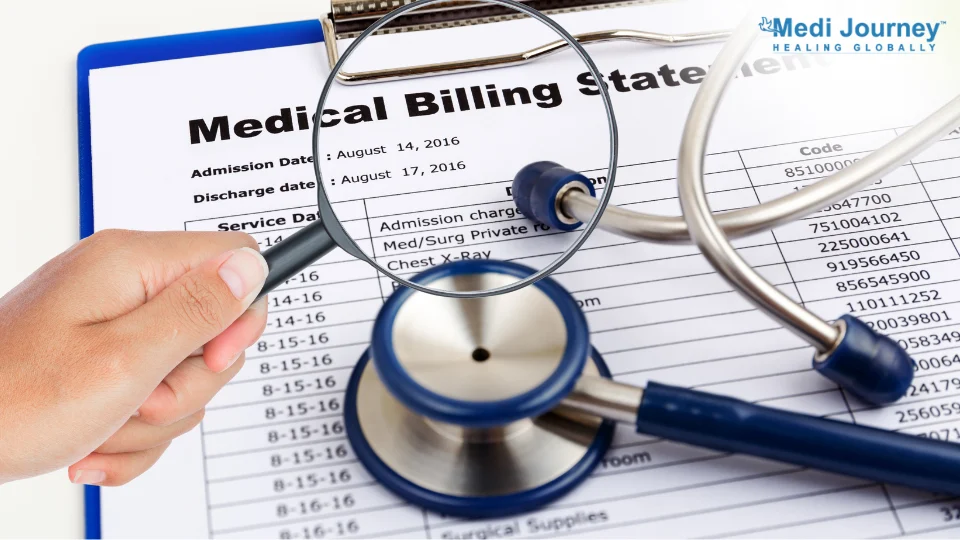
Medical Billing follows a highly standardised system, which is marked with codes. These codes help healthcare providers communicate medical information to payers, such as insurance companies and government programs. There are three essential codes that are used in the billing process, which are ICD-10-CM, CPT, and HCPCS.
Each of these three has a very specific function in capturing the details of patient diagnoses, procedures, and services. Understanding the coding systems is critical. It helps in claims processing, reimbursements, compliance with regulations, and clear medical documentation. The codes are beneficial for a healthcare provider, medical coder, student, and billing professional. Knowing where these codes differ and how they work together is essential for accuracy and efficiency in healthcare administration.
Fill up the form and get assured assitance within 24 hrs!
ICD-10-CM stands for the International Classification of Diseases, 10th Revision, Clinical Modification. This code set is developed and maintained by the Centers for Disease Control and Prevention (CDC) and is based on the World Health Organization’s ICD-10.
ICD-10-CM codes are used to classify and document diagnoses and reasons for medical services. For example, a patient diagnosed with Type 2 Diabetes would be assigned an ICD-10-CM code like E11.9 ("Type 2 diabetes mellitus without complications").
Key Features:
Example ICD-10-CM Codes:
These codes provide diagnostic context and justify the need for services or procedures. Insurance companies use ICD-10-CM codes to determine medical necessity for treatments.
Get help choosing the best doctor and hospital for your care.
CPT, or Current Procedural Terminology, is a code set maintained by the American Medical Association (AMA). CPT codes describe medical, surgical, and diagnostic procedures and services provided by healthcare professionals.
Unlike ICD-10-CM, which explains why a service was needed, CPT codes explain what was done. For example, an office visit for evaluation and management may be coded as 99213, while the removal of a mole may be coded as 11400.
Key Features:
Example CPT Codes:
CPT codes are submitted on claims forms to insurers to request payment for services rendered. They are a central part of revenue cycle management in physician practices and outpatient settings.
HCPCS, or Healthcare Common Procedure Coding System, is a set of codes developed by the Centers for Medicare & Medicaid Services (CMS). It was created to supplement CPT codes, particularly for services not covered by CPT, such as ambulance rides, durable medical equipment (DME), and certain medications.
HCPCS is divided into two levels:
Key Features:
Example HCPCS Level II Codes:
These codes are crucial for billing non-physician services and are updated annually by CMS.
Get help choosing the best doctor and hospital for your care.
Here’s a clear comparison of ICD-10-CM, CPT, and HCPCS codes to help distinguish their specific roles in medical billing and documentation:
|
Feature |
ICD-10-CM |
CPT |
HCPCS Level II |
|
Purpose |
Diagnosis coding |
Procedure and service coding |
Non-physician services and supplies |
|
Maintained by |
CDC (U.S. adaptation of WHO) |
American Medical Association |
Centers for Medicare & Medicaid Services |
|
Format |
Alphanumeric (3–7 characters) |
Numeric (5 digits) |
Alphanumeric (1 letter + 4 digits) |
|
Usage |
All healthcare settings |
Outpatient, physician billing |
Medicare/Medicaid, supplies, DME |
|
Examples |
E11.9, I10, M54.5 |
99213, 93000, 11400 |
A0428, E0110, J3490 |
Accurate and appropriate use of ICD-10-CM, CPT, and HCPCS codes ensures:
Mistakes in coding, such as mismatching diagnoses with procedures, can lead to claim denials, revenue loss, audits, or even penalties under programs like Medicare.
Get help choosing the best doctor and hospital for your care.
In medical billing, a single patient encounter often involves multiple types of codes. Each code set, ICD-10-CM, CPT, and HCPCS, serves a distinct but interconnected purpose. Together, they create a comprehensive record that explains why the patient was seen, what was done, and what resources were used.
Example of an Integrated Claim
Let’s say a patient visits an orthopedic clinic with complaints of persistent lower back pain:
By submitting all three types of codes together, the claim communicates:
Medical billing code systems like ICD-10-CM, CPT, and HCPCS are not static. These codes evolve every year. The graph below shows how the number of new or revised codes has increased steadily from 2010 to 2025. This highlights the growing complexity and importance of staying updated to avoid errors, claim rejections, or compliance issues.
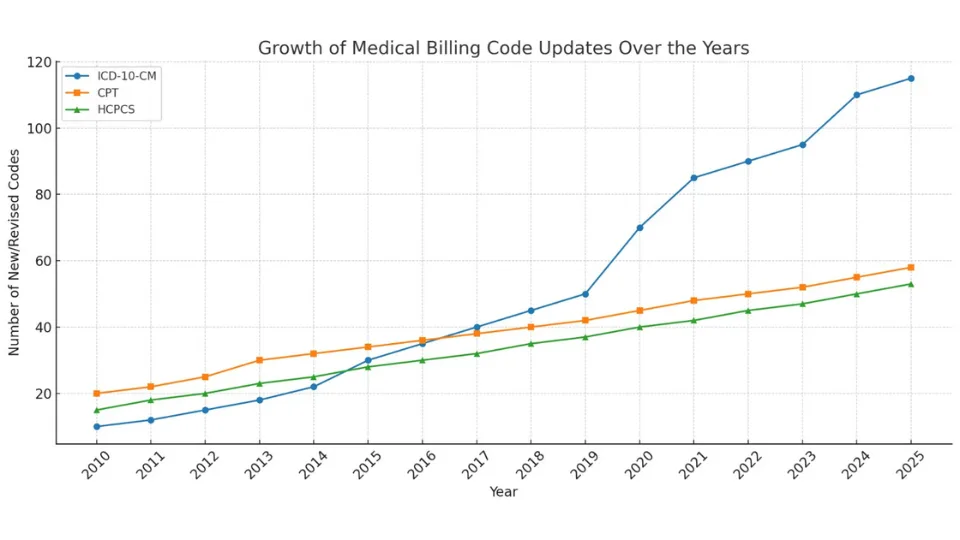
As these updates accelerate, healthcare professionals, coders, and billing staff must stay informed to ensure accurate documentation and reimbursement.
We can easily conclude that ICD-10-CM, CPT, and HPCS codes are the foundation of medical billing. Each code serves a distinct role. ICD-10-CM captures the diagnosis, while CPT defines the procedures or services provided, and HCPCS addresses equipment, supplies, and services outside the scope of CPT.
Healthcare providers and insurance companies need these codes primarily. Understanding these codes' function and their purpose, and how they are related to one another, is crucial for effective documentation, coding, billing, and compliance. Correct coding and understanding practices can help avoid claim rejections, ensuring accurate payments and maintaining regulatory integrity in patient care.
Fill up the form and get assured assitance within 24 hrs!
B.Sc in Media Science from NSHM Knowledge Campus, Kolkata, 2019-2022
Suryani Dutta is an experienced healthcare content writer with 4+ years of experience creating patient-centric healthcare content. She has developed over 2,000 blogs and web pages, 2,000+ social media creatives, 200+ video scripts, and hundreds of SEO-opt
Dr. Charu Gauba is a Neurologist with over 32 years of experience. She specializes in various neurological procedures, such as Cerebrospinal Fluid Shunt, Spinal Tap, Digital Subtraction Angiography (DSA), Ventriculoperitoneal Shunt, and Brain Mapping....
Senior Consultant
Medical Oncologist
Nanavati Max Super Speciality Hospital Mumbai
WhatsApp UsSenior Director
Gynecologist and Obstetrician, IVF Specialist
Max Super Speciality Hospital, Shalimar Bagh, New Delhi
WhatsApp UsSenior Director
Gynecologist and Obstetrician, IVF Specialist
Max Smart Super Speciality Hospital, Saket, New Delhi
WhatsApp UsSenior Director
Gynecologist and Obstetrician
Max Smart Super Speciality Hospital, Saket, New Delhi
WhatsApp UsSenior Director
Gynecologist and Obstetrician
Max Smart Super Speciality Hospital, Saket, New Delhi
WhatsApp UsSenior Director
Gynecologist and Obstetrician
Max Smart Super Speciality Hospital, Saket, New Delhi
WhatsApp UsThe Art of Effective Communication
04 February,2026
Read More
02 February,2026
Read More
27 January,2026
Read More
20 January,2026
Read More
Trusted by Patients
"I am Asim from Bangladesh and was looking for treatment in India for neuro. I visited many websites to get the complete information regarding the treatment but I was not satisfied as I was getting confused. In the meanwhile, one of my friends suggested I seek help from Medi Journey as he experienced his medical journey very smoothly and was satisfied with it. They have filtered the top 10 doctors as per experience, the success rate of surgery & profile, so it helps us to choose the best treatment in India. "
"For my knee surgery, Medi Journey guided me to BLK Hospital where I received exceptional care. The team's support and the expertise at BLK Hospital exceeded my expectations. Thank you Medi Journey for making my medical journey stress-free. "
"I came from Iraq for my granddaughter's eye surgery in India facilitated by Medi Journey, due to critical cases they advised us to get a second opinion from the different hospitals before going to surgery. Finally, we went to Fortis Escort Hospital, which helped us to get more confidence for diagnosis. Fortis Escort Hospital has the best eye surgeon team with the latest instruments. Thanks to all team members for providing a high-quality treatment in India at an affordable cost. "
"I came for my hair transplant in India, before coming I was so confused about choosing the best clinic and surgeon for me. But thanks to God one of my friends had a hair transplant in India through Medi Journey. He recommended me to go with them. I am completely happy with my experience with them. They were always very fast in their responses to me. the success rate of my hair transplant surgery is 100%."
"Artemis Hospital, suggested by Medi Journey, turned out to be a great choice for my treatment. The personalized assistance and medical care were exceptional. I'm grateful to Medi Journey for guiding me to a hospital that perfectly matched my needs. Highly recommended! "
"I came from Afghanistan for my treatment in India at Jaypee Hospital, Noida. I had a fantastic experience with Medi Journey. Kudos to them for their incredible support during my medical journey. They not only took care of all the logistics but also connected me with a fantastic healthcare team. Efficient, caring, and highly recommended for a hassle-free medical tourism experience."
"I am Adam from Kano, Nigeria, one of my friends from Nigeria was facilitated by Medi Journey, and he recommended us to go with them. I sent my all reports to them and within 48 hours they reverted with 4 options from different hospitals. They helped me to get a Visa letter from the hospital, arrange pick-up from the airport, and book a hotel for me. Their team is very honest and throughout our stay in India they are with us they are caring for us like his family members. BLK Hospital is the best hospital in India with a top surgical oncologist surgeon team, a very advanced OT, and a Radiotherapy department. I wish more success to Medi Journey. "
"Great experience at the Max Hospital for my spine surgery and was successfully done. I thank my neurosurgeon and his entire team. I recommended all of my country's people to Medi Journey for treatment in India, they choose the best hospital, the best doctors, and the best cost for patients."
"I came to India from Dhaka, Bangladesh for my father-in-law's cardiac surgery at Fortis Hospital. I was confused about choosing the best surgeon for him before coming, but their team helped me to choose the best hospital and best cardiac surgeon in India with very good cost and 100% success rate of surgery. I am very happy with the services, really they make my journey so comfortable that make me feel at home. Thanks again and I like people to choose "Medi Journey" as your travel guide. "
"I am Mohammad from Bangladesh came to India for my general health checkup. Medi Journey offers me the complete package including Pick-up from the airport, hotel services, and 24-hour assistance. They guide you to choose the best hospital in India, the best cost of treatment with top-most doctors and give you complete information about hotel booking, and pick-up from the airport before coming to India They have the best team to help. Always choose Medi Journey for your treatment in India."