

Breakthrough Cancer Treatment: Scientists Create Cancer-Fighting Cells Inside the Body
 26 March,2026
Read More
26 March,2026
Read More


Enquire now in case of any assistance needed
17 July,2025
Spine issues like herniated discs, vertebral compression fractures, spinal stenosis, and spondylolisthesis affect millions of people in India. These conditions often lead to chronic pain, limited movement, and reduced quality of life.
While surgery is sometimes necessary, the Indian government now emphasizes a broader spectrum of non-surgical spine treatment in India, along with minimally invasive treatments. It is offered under the flagship schemes. These options aim to ensure safe, effective, and affordable care before resorting to surgical intervention.
Fill up the form and get assured assitance within 24 hrs!
Launched in September 2018, Ayushman Bharat–PMJAY covers INR 5 lakh per family per year for hospital treatments at empaneled public and private facilities. While surgical spine care is included, so too are many non-surgical approaches—from rehabilitation therapies to targeted pain relief procedures.
These interventions are bundled into Health Benefit Packages (HBPs), carefully designed by the National Health Authority to standardize costs and quality.
The first line of defence in spine care is often physical therapy. In public and PMJAY?empaneled hospitals, physiotherapy departments offer:
These therapies are covered as part of outpatient and inpatient care, often during the pre- and post-hospitalization window provided by PMJAY. For many patients, structured rehabilitation can significantly reduce pain without surgical risk.
Ayushman Bharat and several state-level programs support pain management clinics in tertiary hospitals. These clinics offer:
These options are covered under PMJAY packages for chronic back and neck pain, emphasizing non-surgical treatment whenever feasible. These are all key parts of interventional pain management in India.
For patients whose pain does not respond to therapy or medication, the government supports several advanced, minimally invasive options:
All these procedures can be followed by physiotherapy for the spine in India.
In rare cases of chronic, severe pain not responding to other measures, advanced treatment like spinal cord stimulation or implantable neuromodulation devices is available.
These devices use electrical impulses to block or alter pain signals before they reach the brain.
Standard non-surgical management, including pain relievers, muscle relaxants, physical aids (such as braces and collars), and patient education, remains critical. Public hospitals under PMJAY offer these services, often in addition to outpatient packages.
Hospitals also advise on lifestyle changes, such as weight loss, regular exercise, proper lifting techniques, and adjustments to posture. Such measures help manage spinal conditions and prevent long-term damage.
Get help choosing the best doctor and hospital for your care.
Recent updates to HBPs have integrated non-surgical spine care more fully. A standard model encourages conservative care first, followed by escalation to minimally invasive procedures if needed.
The government also promotes AYUSH treatments (Yoga, Ayurveda) for chronic back pain and prevention. Yoga-based rehabilitation programs are being planned in public facilities as adjunct therapy.
Under the Ayushman Bharat Digital Mission, patient records cover physiotherapy, procedures, prescriptions, and follow-ups. This ensures continuity of care and enables remote or telemedicine follow-ups.
A patient diagnosed with a herniated disc can, under PMJAY, receive free sessions of physiotherapy, pain injections, vertebroplasty (if osteoporosis is involved), and follow-up diagnostics. If conservative care proves insufficient, the same policy supports minimally invasive procedures like endoscopic intervention or spinal injections, avoiding open surgery.
For vertebral compression fractures, vertebroplasty can prevent prolonged hospital stays. Patients receive cement injection within days, leading to significant pain relief and quicker mobility.
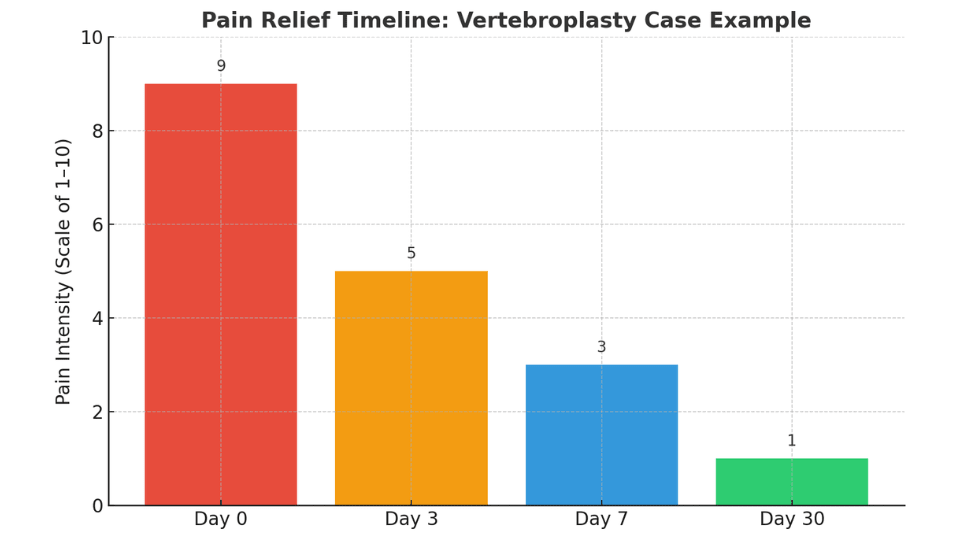
Here's the graph showing the Pain Relief Timeline after Vertebroplasty, with a clear drop in pain intensity from Day 0 to Day 30.
In remote areas, physiotherapy outreach teams combined with tele-rehab services act as a bridge until the patient can access clinical services. This layered model shows how non-surgical spine care has become a practical reality across India.
Get help choosing the best doctor and hospital for your care.
Despite progress, gaps remain. Public awareness about non-surgical spine treatment in India is still low, and many patients are referred directly for surgery without trying conservative measures. The empanelment of non-surgical spine providers in rural areas is limited, resulting in reduced access to local care.
Capacity limitations at tertiary centers, particularly for specialized procedures such as vertebroplasty or endoscopic techniques, result in some regions being underserved. Digital health expansion is promising, but it requires investment in rural connectivity and the training of personnel.
India's healthcare system is undergoing a significant transformation. Spine care is no longer defined solely by surgery. It includes effective, evidence-based non-surgical alternatives. With Ayushman Bharat–PMJAY, services like physiotherapy, pain management, vertebroplasty, spine endoscopy, and neuromodulation have become accessible and affordable for underserved populations.
Non-surgical spine care offers safer, quicker, and sometimes equally effective solutions without the costs and risks of open surgery. Continued efforts to raise public awareness, train providers, expand digital systems, and standardize delivery protocols will further strengthen these options. It ensures that spine care in India remains close to home, is smartly managed, and is truly patient-centered.
Answer: You can try treatments like acupuncture, massage therapy, laser therapy, or electrical nerve stimulation. These methods help alleviate pain and enhance mobility. They are generally safe for most people and can be used in conjunction with other treatments.
Answer: If your back pain is mild to moderate and not caused by a serious injury, it's a good idea to start with non-surgical treatments. These methods are less risky and often very effective. However, if the pain doesn't improve, consult a doctor about other treatment options.
Answer: Spinal stenosis can be effectively managed through a combination of treatments. Taking warm baths, using a heating pad, sleeping in a better position, or adjusting your workspace can all help. Medicines, physical therapy, and injections may also reduce pain and stiffness.
Fill up the form and get assured assitance within 24 hrs!
B.Sc in Media Science from NSHM Knowledge Campus, Kolkata, 2019-2022
Suryani Dutta is an experienced healthcare content writer with 4+ years of experience creating patient-centric healthcare content. She has developed over 2,000 blogs and web pages, 2,000+ social media creatives, 200+ video scripts, and hundreds of SEO-opt
A renowned Neuro-spine Surgeon, Dr. S K Rajan, has successfully performed over 3000 surgeries, including intricate spine cases. With over 25 years of experience, his expertise lies in minimally invasive (keyhole) spine surgery, Craniovertebral junction (...
Senior Consultant
Medical Oncologist
Nanavati Max Super Speciality Hospital Mumbai
WhatsApp UsSenior Director
Gynecologist and Obstetrician, IVF Specialist
Max Super Speciality Hospital, Shalimar Bagh, New Delhi
WhatsApp UsSenior Director
Gynecologist and Obstetrician, IVF Specialist
Max Smart Super Speciality Hospital, Saket, New Delhi
WhatsApp UsSenior Director
Gynecologist and Obstetrician
Max Smart Super Speciality Hospital, Saket, New Delhi
WhatsApp UsSenior Director
Gynecologist and Obstetrician
Max Smart Super Speciality Hospital, Saket, New Delhi
WhatsApp UsSenior Director
Gynecologist and Obstetrician
Max Smart Super Speciality Hospital, Saket, New Delhi
WhatsApp UsThe Art of Effective Communication
04 February,2026
Read More
02 February,2026
Read More
27 January,2026
Read More
20 January,2026
Read More
Trusted by Patients
"I am Asim from Bangladesh and was looking for treatment in India for neuro. I visited many websites to get the complete information regarding the treatment but I was not satisfied as I was getting confused. In the meanwhile, one of my friends suggested I seek help from Medi Journey as he experienced his medical journey very smoothly and was satisfied with it. They have filtered the top 10 doctors as per experience, the success rate of surgery & profile, so it helps us to choose the best treatment in India. "
"For my knee surgery, Medi Journey guided me to BLK Hospital where I received exceptional care. The team's support and the expertise at BLK Hospital exceeded my expectations. Thank you Medi Journey for making my medical journey stress-free. "
"I came from Iraq for my granddaughter's eye surgery in India facilitated by Medi Journey, due to critical cases they advised us to get a second opinion from the different hospitals before going to surgery. Finally, we went to Fortis Escort Hospital, which helped us to get more confidence for diagnosis. Fortis Escort Hospital has the best eye surgeon team with the latest instruments. Thanks to all team members for providing a high-quality treatment in India at an affordable cost. "
"I came for my hair transplant in India, before coming I was so confused about choosing the best clinic and surgeon for me. But thanks to God one of my friends had a hair transplant in India through Medi Journey. He recommended me to go with them. I am completely happy with my experience with them. They were always very fast in their responses to me. the success rate of my hair transplant surgery is 100%."
"Artemis Hospital, suggested by Medi Journey, turned out to be a great choice for my treatment. The personalized assistance and medical care were exceptional. I'm grateful to Medi Journey for guiding me to a hospital that perfectly matched my needs. Highly recommended! "
"I came from Afghanistan for my treatment in India at Jaypee Hospital, Noida. I had a fantastic experience with Medi Journey. Kudos to them for their incredible support during my medical journey. They not only took care of all the logistics but also connected me with a fantastic healthcare team. Efficient, caring, and highly recommended for a hassle-free medical tourism experience."
"I am Adam from Kano, Nigeria, one of my friends from Nigeria was facilitated by Medi Journey, and he recommended us to go with them. I sent my all reports to them and within 48 hours they reverted with 4 options from different hospitals. They helped me to get a Visa letter from the hospital, arrange pick-up from the airport, and book a hotel for me. Their team is very honest and throughout our stay in India they are with us they are caring for us like his family members. BLK Hospital is the best hospital in India with a top surgical oncologist surgeon team, a very advanced OT, and a Radiotherapy department. I wish more success to Medi Journey. "
"Great experience at the Max Hospital for my spine surgery and was successfully done. I thank my neurosurgeon and his entire team. I recommended all of my country's people to Medi Journey for treatment in India, they choose the best hospital, the best doctors, and the best cost for patients."
"I came to India from Dhaka, Bangladesh for my father-in-law's cardiac surgery at Fortis Hospital. I was confused about choosing the best surgeon for him before coming, but their team helped me to choose the best hospital and best cardiac surgeon in India with very good cost and 100% success rate of surgery. I am very happy with the services, really they make my journey so comfortable that make me feel at home. Thanks again and I like people to choose "Medi Journey" as your travel guide. "
"I am Mohammad from Bangladesh came to India for my general health checkup. Medi Journey offers me the complete package including Pick-up from the airport, hotel services, and 24-hour assistance. They guide you to choose the best hospital in India, the best cost of treatment with top-most doctors and give you complete information about hotel booking, and pick-up from the airport before coming to India They have the best team to help. Always choose Medi Journey for your treatment in India."